

Hitting 30 grams of fiber in one day costs 62 cents if you build the day from the dry goods aisle, and $14.42 if you let restaurants do it for you. Same nutrient, same day, 23 times the price. That’s the whole study in two sentences, and the rest of this article is the receipts.
This is the third spreadsheet in the series. First we ranked 53 foods by fiber per dollar, then 49 foods by protein per dollar. Readers kept asking the practical follow-up: fine, beans win, but what does an actual day cost? So I priced five realistic ways to land at roughly 30 grams, meal by meal.
How we priced a 30-gram day
No new data collection, and that’s the point. Every grocery number below reuses the audited dataset from the fiber per dollar study: fiber per 100 grams from USDA FoodData Central, and July 2026 US prices from Walmart national listings cross-checked against Bureau of Labor Statistics averages, all re-verified on July 4, 2026. The restaurant day uses the fiber figures we already published in our high fiber fast food guide, which come from each chain’s own nutrition pages, matched to typical national menu prices as of July 2026.
Three ground rules so nobody has to squint at the math:
- We priced the fiber-carrying foods only. The 62-cent day assumes your pantry supplies salt, oil, and whatever protein lands next to the beans. The restaurant day buys complete meals, so it gets a built-in head start in the fairness department and still loses by a mile.
- Dry goods are measured dry, fruit is measured as purchased. Fiber on peeled fruit counts only the edible portion, same as the parent study. You can’t eat a banana peel no matter what the sticker says.
- Every day lands between 31 and 32.1 grams. The FDA’s Daily Value is 28 grams; 30 is the round number everyone actually searches for. All five plans clear both.
The full dataset is public. Download the raw CSV here, check any row against the parent dataset, or run your own matchups in the Fiber per Dollar Calculator.
Day 1: The rock-bottom dry goods day ($0.62)
This is the floor. Nobody’s saying it’s exciting. It is, however, 31.9 grams of fiber for less than the sales tax on a latte.
| Meal | Food + amount | Fiber | Cost |
|---|---|---|---|
| Breakfast | Rolled oats, 60g dry (2/3 cup) | 6.1 g | $0.17 |
| Lunch | Split pea soup from 50g dry split peas | 11.1 g | $0.16 |
| Dinner | Pinto beans, 60g dry (1/3 cup) | 9.3 g | $0.13 |
| Dinner | Brown rice, 50g dry (1/4 cup) | 1.8 g | $0.10 |
| Snack | Popcorn, 25g kernels (2 tbsp) | 3.6 g | $0.06 |
| Total | 31.9 g | $0.62 |
The lunch is a small bowl of split pea soup, which does more fiber work per penny than anything else in the store. If the dinner beans feel like a project, the same-day quick soak turns dry pintos into tonight’s food instead of tomorrow’s.
Day 2: The no-cook convenience day ($1.74)
Zero pots. The most demanding step is a microwave and a can opener, and it still clears 30 grams.
| Meal | Food + amount | Fiber | Cost |
|---|---|---|---|
| Breakfast | Bran flakes, 45g (about 1.5 cups) | 8.2 g | $0.27 |
| Lunch | Whole wheat bread, 2 slices (52g) | 3.1 g | $0.18 |
| Lunch | Peanut butter, 32g (2 tbsp) | 1.6 g | $0.14 |
| Lunch | Prunes, 40g (about 5) | 2.8 g | $0.35 |
| Dinner | Canned chickpeas, 1/2 can (220g) | 10.6 g | $0.49 |
| Snack | Frozen green peas, 120g, microwaved | 5.4 g | $0.31 |
| Total | 31.7 g | $1.74 |
Convenience from a can costs about a dollar more per day than cooking from scratch. Hold that thought until Day 4, where convenience from a drive-thru costs twelve dollars more.
Day 3: The fresh produce lover day ($4.18)
For the person whose cart is 80 percent plants and who has opinions about avocado ripeness. Delicious, legitimate, and the most expensive way to do this inside a grocery store.
| Meal | Food + amount | Fiber | Cost |
|---|---|---|---|
| Breakfast | Raspberries, one 6 oz box (170g) | 11.1 g | $2.48 |
| Breakfast | 1 medium banana | 3.1 g | $0.26 |
| Lunch | 1 avocado (200g whole) | 9.9 g | $0.95 |
| Lunch | Carrots, 100g | 2.8 g | $0.17 |
| Dinner | 1 small sweet potato (150g) | 4.5 g | $0.32 |
| Total | 31.4 g | $4.18 |
One detail worth staring at: the raspberry box is 59 percent of the day’s entire cost. Berries were the bottom four of our original ranking, and they’re doing it again here. Swapping half the fresh items for their freezer-aisle versions closes a lot of the gap, which is exactly what we found when we compared frozen versus fresh produce.
Day 4: The restaurant day ($14.42)
Nothing home-cooked, nothing from a grocery store. Fiber figures are the ones we verified from chain nutrition pages in our fast food guide; prices are typical national menu prices from July 2026, so your city will wobble a dollar or two in either direction.
| Meal | Food + amount | Fiber | Cost |
|---|---|---|---|
| Breakfast | Starbucks classic oatmeal with nut and fruit toppings | 6.0 g | $4.25 |
| Lunch | Wendy’s plain baked potato | 7.0 g | $3.29 |
| Lunch | Wendy’s large chili | 9.0 g | $4.39 |
| Dinner | Taco Bell bean burrito | 9.0 g | $2.49 |
| Total | 31.0 g | $14.42 |
And honestly, this is the smart version of the restaurant day. These are the best fiber orders in fast food, picked from menus that are mostly fiber deserts. The one-stop alternative is a Chipotle bowl with brown rice, double beans, and guacamole at about 25 grams, but at roughly $12.75 for the chicken version with guac, that single bowl costs more than twenty rock-bottom days.
Day 5: The realistic mixed day ($1.99)
Nobody eats like Day 1 forever, and nobody should eat like Day 4 forever unless they enjoy lighting money on fire. This is the day I’d actually defend: some fruit, a normal sandwich, beans doing quiet work at dinner.
| Meal | Food + amount | Fiber | Cost |
|---|---|---|---|
| Breakfast | Rolled oats, 50g dry (1/2 cup) | 5.1 g | $0.14 |
| Breakfast | 1 medium banana | 3.1 g | $0.26 |
| Lunch | Whole wheat bread, 2 slices (52g) | 3.1 g | $0.18 |
| Lunch | Peanut butter, 32g (2 tbsp) | 1.6 g | $0.14 |
| Lunch | 1 medium apple | 3.9 g | $0.51 |
| Dinner | Canned black beans, 1/2 can (220g) | 12.3 g | $0.44 |
| Dinner | Frozen broccoli, 100g | 3.0 g | $0.32 |
| Total | 32.1 g | $1.99 |
Two bucks. That’s a completely normal day of food, no split-pea heroics required, and the fiber may help keep you full enough that the vending machine stops being part of your afternoon.
What the five days actually say
The spread is 23x. $0.62 to $14.42 for the same job. If you only remember one number from this study, that’s the one.
Convenience has two very different price tags. The can-and-microwave day costs $1.12 more than cooking from scratch. The drive-thru day costs $13.80 more. Cans are cheap convenience; counters with cash registers are not.
Fresh produce is a flavor budget, not a fiber budget. The produce day costs roughly twice the mixed day and almost seven times the dry goods day. Buy the raspberries because you love them, and let beans carry the gram count.
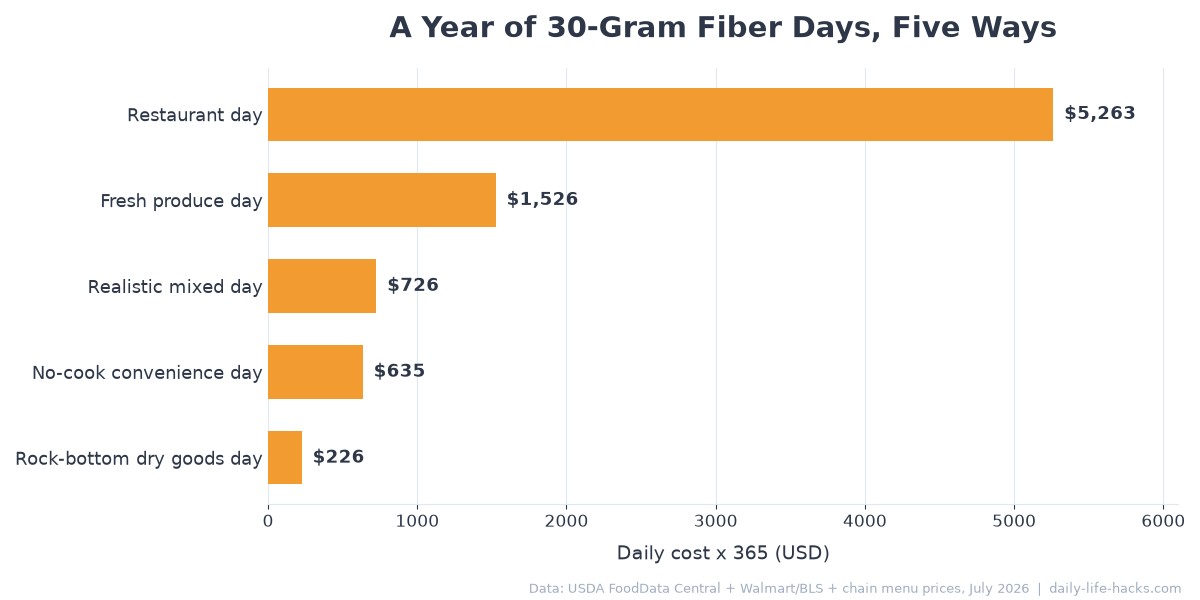
The year math is where it gets loud. At 365 days, the five plans cost about $226, $635, $726, $1,526, and $5,263 in fiber-carrying foods. The gap between eating your 30 grams from restaurants and eating them from a mixed grocery cart is about $4,500 a year, which is a used car, or a very nice vacation, or a lot of raspberries.
How to actually use this
Don’t pick one day and marry it. Steal the structure instead:
- Let one dry-goods item anchor each day. Oats at breakfast or beans at dinner drops any day’s cost by more, per gram, than any other single swap.
- Keep the no-cook day in your back pocket. $1.74 and zero dishes is the honest answer for the weeks when cooking isn’t happening.
- Treat the restaurant orders as emergency plays. They’re in our fast food guide for the days the drive-thru wins, not as a plan.
- Want the full system? The complete guide to eating more fiber on a budget turns these numbers into shopping lists and weekly routines.
The whole study comes down to this: 30 grams of fiber is not expensive. It never was. The expensive part is paying someone else to open the can, and the drive-thru charges 23 times the dry goods aisle for the exact same nutrient. Now you know the exact markup.


