
By David Miller
How much selenium is in the groceries, and what did that serving cost?
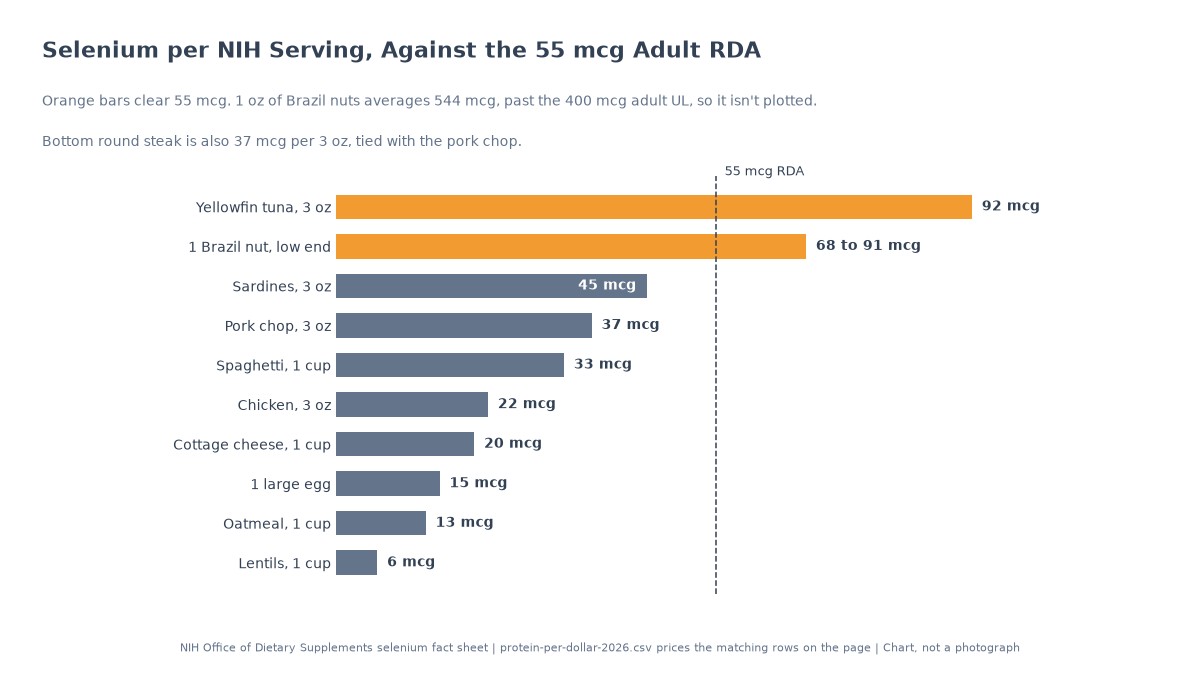
The Brazil nut is the one grocery that can blow a selenium daily intake without looking like a project. The NIH Office of Dietary Supplements puts one nut at 68 to 91 mcg. The adult RDA is 55 mcg. An ounce, 6 to 8 nuts, averages 544 mcg, and the adult ceiling is 400.
Pick the servings you actually eat. The total is the percent of that 55 mcg line, with a flag if the day crosses 400. Where the grocery row is the same food, the price comes from protein-per-dollar-2026.csv. Yellowfin tuna keeps its 92 mcg and doesn't get a made-up dollar. There's no pill row on this page.
Build a selenium daily intake from the NIH table
The ordinary day already filled in is one large egg (15 mcg), one cup of cooked spaghetti (33 mcg), and 3 ounces of roasted chicken (22 mcg). That's 70 mcg, 127.3% of the adult RDA, at $1.13 for the priced grams. Still under 400. The selenium foods writeup is the same NIH table in paragraph form.
70 mcg, 127.3% of the 55 mcg adult RDA. That stays under the 400 mcg NIH ceiling. Priced servings come to $1.13. Every serving in this mix has a row in protein-per-dollar-2026.csv.
Serving counts stay in this browser tab. The page can record that the tool was used. It doesn't send the foods you picked.
| Food | NIH serving | Selenium | % of 55 mcg | Servings | Price per serving | What got priced |
|---|---|---|---|---|---|---|
| Brazil nuts | 1 nut (NIH: 68 to 91 mcg) | 68 to 91 mcg | 123.6% to 165.5% | not in the file | Not in protein-per-dollar-2026.csv. An ounce, 6 to 8 nuts, averages 544 mcg on the NIH fact sheet. | |
| Yellowfin tuna, cooked | 3 oz | 92 mcg | 167.3% | not in the file | Not in protein-per-dollar-2026.csv. Canned chunk light tuna is a different fish, so this page doesn't borrow its price. | |
| Sardines, canned in oil | 3 oz | 45 mcg | 81.8% | $1.03 | 85 g of Sardines (canned in oil, drained) in protein-per-dollar-2026.csv. | |
| Shrimp, cooked | 3 oz | 42 mcg | 76.4% | not in the file | Not in protein-per-dollar-2026.csv. | |
| Pork chop, broiled | 3 oz | 37 mcg | 67.3% | $0.80 | 85 g raw of Pork loin chops (boneless). NIH's 37 mcg is a broiled chop, so this dollar is the raw stand-in. | |
| Beef steak, bottom round | 3 oz | 37 mcg | 67.3% | not in the file | Not in protein-per-dollar-2026.csv. Ground beef is a different cut, so it doesn't get this 37 mcg. | |
| Spaghetti, cooked | 1 cup | 33 mcg | 60% | $0.17 | 56 g dry of Spaghetti (regular, dry), about 2 oz, for 1 cup cooked. | |
| Turkey, roasted | 3 oz | 26 mcg | 47.3% | not in the file | Not in protein-per-dollar-2026.csv. Ground turkey isn't roasted turkey. | |
| Pacific cod, cooked | 3 oz | 24 mcg | 43.6% | not in the file | Not in protein-per-dollar-2026.csv. | |
| Chicken, light meat, roasted | 3 oz | 22 mcg | 40% | $0.78 | 85 g raw of Chicken breast (boneless, skinless). NIH's 22 mcg is roasted light meat, so cooked ounces can cost more than this. | |
| Cottage cheese, 1% | 1 cup | 20 mcg | 36.4% | $0.95 | 226 g of Cottage cheese (4%). NIH's 20 mcg is the 1% cup, and the file prices the 4% tub. | |
| Egg, hard-boiled | 1 large | 15 mcg | 27.3% | $0.18 | 50 g of Eggs (large). The file's dozen is 600 g. | |
| Oatmeal, cooked with water | 1 cup | 13 mcg | 23.6% | $0.11 | 40 g dry of Old-fashioned rolled oats, about a half cup, for 1 cup cooked. | |
| Brown rice, cooked | 1 cup | 12 mcg | 21.8% | $0.13 | 62 g dry of Brown rice (dry), about a third of a 185 g dry cup, for 1 cup cooked. | |
| Yogurt, plain, low fat | 1 cup | 8 mcg | 14.5% | not in the file | No matching row. The file's Greek yogurt isn't this low-fat cup. | |
| Lentils, boiled | 1 cup | 6 mcg | 10.9% | $0.24 | 76 g dry of Brown lentils (dry). A pound cooks to about 6 cups, so one cooked cup is about 76 g of the bag. |
The 55 mcg line and the 400 mcg ceiling
Eight nuts at the 68 mcg low end land on 544 mcg, the same figure NIH gives for a 1-ounce average. That isn't proof every nut in the bag is 68 mcg. The fact sheet says the ounce average comes from USDA FoodData Central and that other analyses vary widely. Six nuts at 68 mcg is 408 mcg, already over the ceiling. NIH says Brazil nuts could cause selenium toxicity if eaten regularly. One nut covers the day. A handful is a different hobby.
Seafood, eggs, and grains do the ordinary work. Sardines are the canned fish where the NIH 3-ounce serving and the grocery file are the same kind of fish. The canned fish protein ranking prices that sardine can, plus tuna, on protein per dollar. Eggs are the 15 mcg breakfast shortcut, and the eggs versus everything comparison is where that dozen sits against the rest of the protein file. The full 49-food ranking, quality adjustment included, is protein per dollar adjusted for quality.
Lentils are 6 mcg a cup. They're still worth cooking. They're just not the selenium plan. Soil changes plant foods more than it changes tuna, chicken, and eggs, which is NIH's point, not a reason to skip the oatmeal. How a grocery row earns its USDA record is on the methodology page.
Frequently asked questions
How much selenium do adults need in a day?
Adults 19 and older have a 55 mcg RDA, according to the NIH Office of Dietary Supplements. Pregnancy is 60 mcg and breastfeeding is 70 mcg on that same fact sheet. This calculator uses the 55 mcg adult line. The tolerable upper intake level for adults is 400 mcg a day. Both numbers are reference lines for the servings you add up, not a lab result for the nuts in your pantry.
How much selenium is in one Brazil nut?
NIH puts one Brazil nut at 68 to 91 mcg, already over the 55 mcg adult RDA. An ounce, about 6 to 8 nuts, averages 544 mcg. That ounce is past the 400 mcg ceiling. NIH says Brazil nuts could cause selenium toxicity if eaten regularly, and that the 544 mcg average comes from USDA data that varies widely from bag to bag. One nut is the serving. The ounce is the caution.
Why doesn't yellowfin tuna have a price?
The 92 mcg figure is cooked yellowfin, 3 ounces, from the NIH table. protein-per-dollar-2026.csv doesn't have a yellowfin row. Canned chunk light tuna is in that file, and it's a different fish, so this page doesn't borrow its price or its selenium. Sardines are the seafood row where the NIH serving and the grocery file are the same kind of fish.
Where do the dollar figures come from?
When a NIH serving maps to a grocery row, the price is that row's price per 100 grams in protein-per-dollar-2026.csv, times the grams named in the table. July 2026 is the snapshot. A cooked NIH serving and a raw package aren't the same weigh-in, and the price note says when the page is using raw grams as a stand-in. The methodology page covers how those grocery rows were checked.
Does the calculator save the servings I enter?
No. The serving counts stay in this browser tab. The page can record that the tool was used. It doesn't send the foods you picked or the total. Clear the table and the numbers are gone. There's no account sitting on a Brazil nut count.