

Frozen green peas are the cheapest source of fiber in the entire produce section, at 17.6 grams of fiber per dollar based on USDA data and July 2026 prices. At the other end of the ranking sit blueberries, at 2.5 grams per dollar. That’s a 7x gap between the best and worst deal, and the whole spread happens inside the part of the store everyone assumes is uniformly virtuous.
We ranked 22 common fruits and vegetables by grams of fiber per dollar, pulled from our full fiber per dollar study. Here are the top performers.
| Rank | Food | Fiber per $1 | Package | Price |
|---|---|---|---|---|
| 1 | Frozen green peas | 17.6 g | 32 oz bag | $2.32 |
| 2 | Carrots (whole, bagged) | 16.1 g | 2 lb bag | $1.58 |
| 3 | Green cabbage | 14.6 g | per lb | $0.78 |
| 4 | Sweet potatoes | 13.9 g | per lb | $0.98 |
| 5 | Bananas | 11.6 g | per lb | $0.65 |
| 6 | Frozen green beans | 11.2 g | 32 oz bag | $2.18 |
| 7 | Avocado | 10.4 g | each (~7 oz) | $0.95 |
| 8 | Frozen broccoli florets | 9.5 g | 32 oz bag | $2.87 |
| 9 | Frozen chopped spinach | 8.4 g | 12 oz bag | $1.18 |
| 10 | Frozen shelled edamame | 8.3 g | 12 oz bag | $2.12 |
| 11 | Pears | 8.0 g | per lb | $1.58 |
| 12 | Apples (gala) | 7.7 g | per lb | $1.28 |
Source: USDA FoodData Central + single-store prices, July 2026. Full methodology at /methodology/.
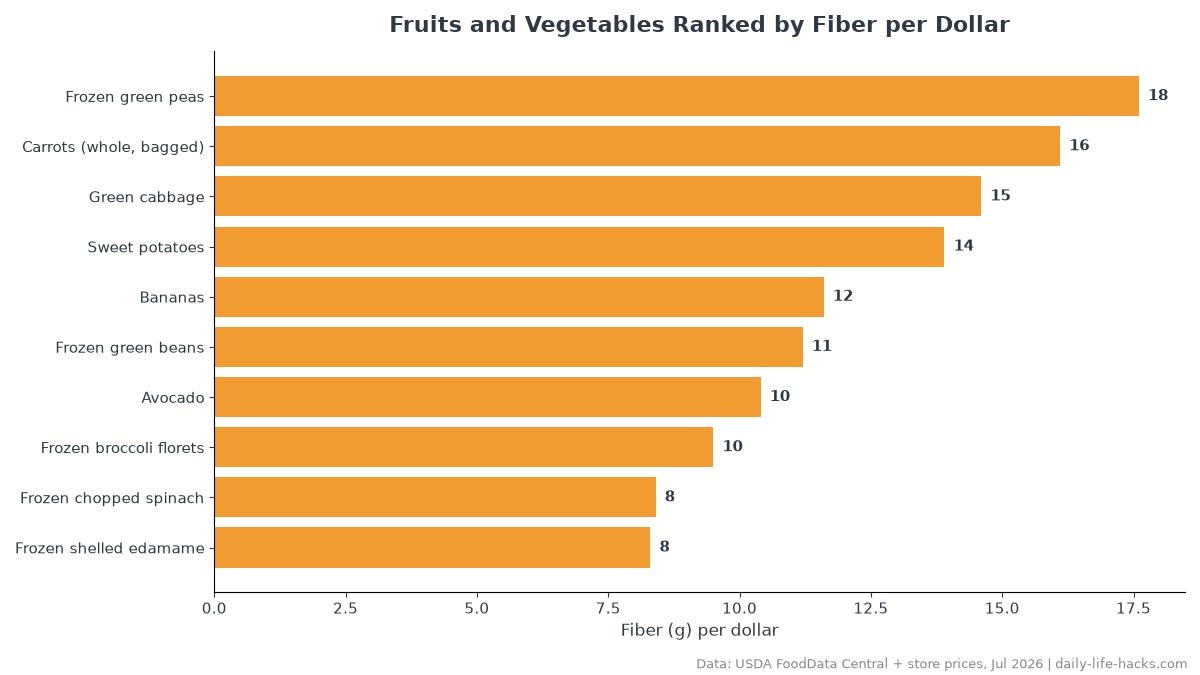
Which vegetables give you the most fiber per dollar?
The winners are the unglamorous ones. Frozen green peas top the whole list, and a $2.32 bag keeps in the freezer until whenever you need it. Bagged whole carrots come in at 16.1 grams per dollar, $1.58 for two pounds, which makes them one of the few snacks that costs less than the vending machine and doesn’t apologize for it.
Then there’s green cabbage at 14.6 grams per dollar and $0.78 a pound. Cabbage is the produce section’s best-kept secret: enormous, nearly indestructible in the fridge, and happy to become slaw, stir-fry, or a big pot of cabbage soup. Sweet potatoes follow at 13.9 grams per dollar, and if you want them before noon, this sheet pan breakfast hash with eggs and sweet potatoes is the move.
Is frozen produce a better fiber deal than fresh?
Mostly, yes, and it isn’t just the peas. Look at broccoli: frozen florets deliver 9.5 grams of fiber per dollar while fresh crowns manage 6.1. Same vegetable, different math, because the frozen bag costs $2.87 for 32 oz while fresh runs $1.94 a pound. Frozen green beans land at 11.2 grams per dollar, and frozen chopped spinach comes in at 8.4 with a $1.18 price tag that makes it the cheapest single item on this list.
Frozen shelled edamame (8.3 grams per dollar) deserves a special mention because it doubles as a snack and a salad. This cucumber and edamame salad with sesame uses one $2.12 bag and takes less time than deciding what show to watch.
The other frozen advantage doesn’t show up in the table: nothing in the freezer turns to compost while you’re busy. A bag of peas may quietly out-earn a bag of fresh greens just by surviving the week.
What fruit has the most fiber for the money?
Bananas, at 11.6 grams per dollar, and it’s mostly a price story: $0.65 a pound makes them the cheapest item in this entire ranking. Avocados surprised me at 10.4 grams per dollar. They have a reputation as a luxury purchase, but at $0.95 each they beat most of the produce section, and avocado toast with beans and seeds stretches one into a real meal.
Pears come in at 8.0 grams per dollar and gala apples at 7.7. Pears are quietly one of the better whole-fruit fiber buys, and a pear salad with walnuts makes them feel like more than a lunchbox item. Navel oranges trail at 6.7.
Are berries really the worst fiber deal in produce?
By this math, yes. Raspberries manage 4.5 grams of fiber per dollar, blackberries 4.0, strawberries 3.4, and blueberries bring up the rear at 2.5. A $2.98 pint of blueberries is a lovely thing. It’s just not a fiber purchase. The frozen peas at the top of this list deliver 7x what blueberries do per dollar, which is the kind of gap you can’t close with good intentions.
The middle of the table has honorable mentions worth knowing: bagged chopped kale at 7.5 grams per dollar (it shines in this Tuscan white bean and kale soup), yellow onions at 7.1, Brussels sprouts at 7.0, and russet potatoes with skin at 6.6 and just $0.89 a pound.
Here’s the honest takeaway: produce is where flavor and vitamins live, but even the best vegetable here can’t touch dried beans and whole grains on fiber per dollar. Use this ranking to pick your produce smartly, then let the complete budget fiber guide show you how the whole cart fits together. Buy the peas, the carrots, and the cabbage. Buy the berries because you like them. Just know which purchase is doing which job.


