

Family week planner
Set the people, the days, and the bowl
The default is 4 people, 7 days, and a half cup cooked each day. Pounds use the Bean Institute and Nebraska Extension yield: 1 pound dry cooks to about 6 cups, and that pound is about 2 cups dry. The can count is shown two ways, because the charts don't agree.
Pinto and black beans are the BLS US average for July 2026. Brown lentils and red lentils are audited Walmart bags in the same study, and those rows don't carry a July date. The one-can swap, including a crowd pot, stays on the dried beans to canned converter. Simmer times for the bag are in how to cook dried beans from scratch. A family cart that also has to clear fiber is the cheapest family grocery basket for protein and fiber. A week that also holds a batch of chicken or pork is a different clock. Cooked meat and poultry are 3 to 4 fridge days on how long cooked meat and poultry last.
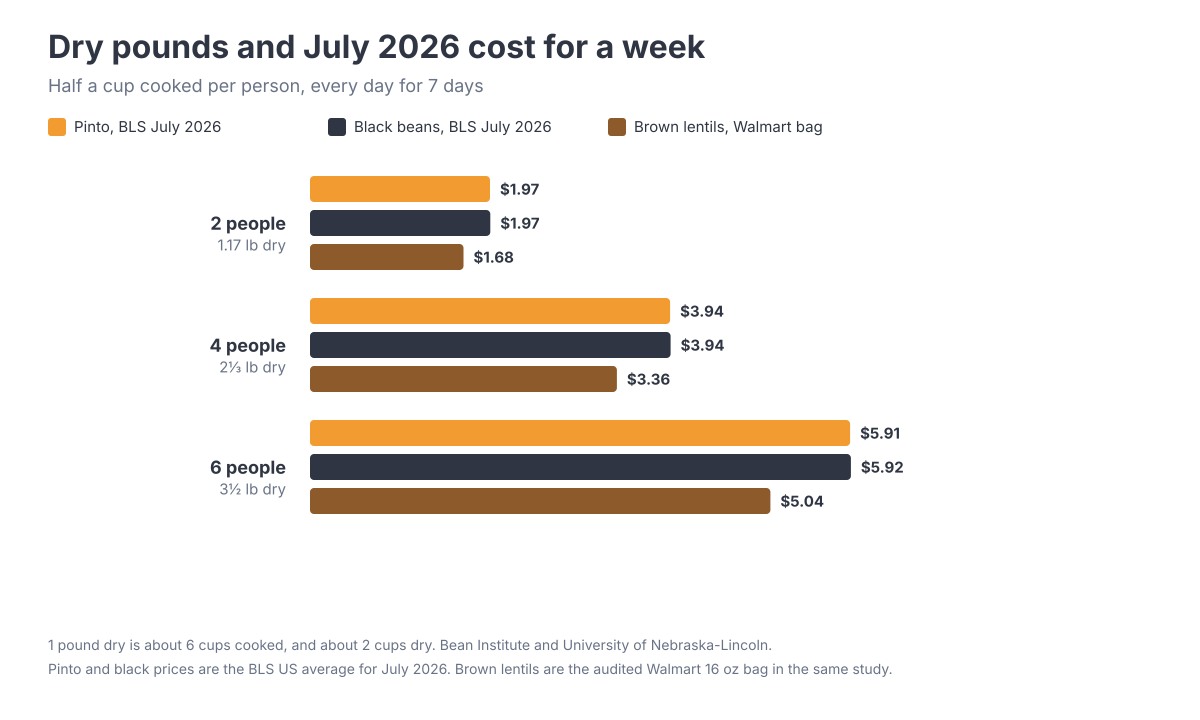
| People | Cooked | Dry weight | Pinto | Black beans | Brown lentils |
|---|---|---|---|---|---|
| 2 | 7 cups | 1.17 lb | $1.97 | $1.97 | $1.68 |
| 4 | 14 cups | 2⅓ lb | $3.94 | $3.94 | $3.36 |
| 6 | 21 cups | 3½ lb | $5.91 | $5.92 | $5.04 |
Red lentils in that same file cost $2.26, $4.52, $6.78 for those three households. The bag is $1.94 for 16 ounces at Walmart, not the July BLS average. Package prices and weights are in the protein per dollar CSV, and the same package prices are in the canned versus dry beans CSV. The method is on the methodology page.
The four-pound bag was the smart purchase. Then it’s Sunday, four people are actually eating, and the bag still won’t tell you how many pounds of dried beans this week is going to take.
A family of 4 eating a 1/2-cup cooked serving a day needs about 2⅓ lb of dry beans for the week. That’s 14 cups cooked, about 4⅔ cups dry. At our July 2026 prices, pinto beans and black beans both land at about $3.94. The chart above is that same half cup for 2, 4, and 6 people. The table under the chart is the bill.
Half a cup is a side, or the beans in a bowl that also has rice. It’s not a full day of calories. If the pot is the whole dinner, you’re in a different math problem, and rice and beans every day already runs that one.
How many pounds of dried beans for a week
Four times seven times a half cup is 14 cups cooked. No yield chart required for that part. The yield chart is what turns cups into a bag.
The Bean Institute lists one pound of dry beans as 2 cups dry and 6 cups cooked, drained. Nebraska Extension says the same thing in one sentence: one pound (2 cups) of dry beans yields about 6 cups cooked. Fourteen divided by 6 is 2⅓ pounds. Two cups per pound times 2⅓ is about 4⅔ cups dry.
I use those figures as exact divisors and keep the word “about,” because both sources put “about” on the cooked yield. Beans aren’t machine screws. An old bag takes longer and can drink a little more water. You still shop the 2⅓ pounds, not a feeling.
The simmer for that bag, including a pressure cooker, is in how to cook dried beans from scratch. Buying the pounds and then boiling them into gravel is a different article, and it’s a shorter tragedy.
Two charts, two can counts
This is the part that looks like a contradiction until you read the cup size.
This site’s converter treats a drained 15.5 ounce can as about 1 1/2 cups, so a pound is about 6 cups and about 3½ to 4 cans. Fourteen cups divided by 1 1/2 is 9⅓ cans. You can’t buy a third of a can, so the shop count rounds up to 10.
The Bean Institute chart counts a 15-ounce can as 1¾ cups cooked, and Nebraska Extension tells you to use 1¾ cups cooked when a recipe says one 15-ounce can. Fourteen divided by 1¾ is 8 cans, even. No rounding.
Eight and 10 aren’t a fight about the family. They’re a fight about how full the can is after you drain it. I print both. The dried beans versus canned beans page uses the same pair, so the week cost over there matches this one.
What July 2026 actually charges
The dollar amounts are package prices from our study, spread across the pounds. Nothing here is a per-pound sticker I made up.
Dry pinto beans are a 4 pound bag at $6.75 for 1,814 grams. Dry black beans are a 2 pound bag at $3.38 for 907 grams. Both are the Bureau of Labor Statistics US average for July 2026. Two and a third pounds of either bag is $3.94. At six people the penny shows up: pintos are $5.91 and black beans are $5.92. Same yield, slightly different price per gram. I’m not going to call that a tie and hide it.
Brown lentils are $1.44 for a 16 ounce bag, 454 grams, and this week is $3.36. Red lentils are $1.94 for the same size bag, and the week is $4.52. Those two are audited Walmart prices in the file. They don’t have a July 2026 date on the row. If your store isn’t that bag, the planner’s pounds still hold and the dollars don’t. The full method, including what we refused to guess, is on the methodology page.
Canned black beans are $0.88 for a 15.5 ounce can, also a Walmart price without a July date. Eight cans cost $7.04. Ten cans cost $8.80. We priced canned black beans, kidney beans, and chickpeas. We didn’t price a can of pintos, so the can bill is the black bean can. Using the pinto price for a can we never bought would be fiction.
The dry week is the cheaper one in this set. That’s the bag doing its job. The can is the Tuesday when you didn’t soak anything, and it’s still beans.
Shop the week you actually eat
Change the headcount if four isn’t your house. Two people at the same half cup need 1.17 pounds and about $1.97 of pintos or black beans. Six people need 3½ pounds, $5.91 of pintos or $5.92 of black beans. Seven days, half a cup, every time. A chili night that wants a full cup per person is a different setting in the planner, not a different law of beans.
Cook them before you need them. A Sunday pot covers the tacos and the bowls, and the leftovers question is the fridge, not another bag. Weigh the 2⅓ pounds, rinse them, and give them the time on the cook page. The bag was already the right purchase. Now you know how much of the bag is dinner.


