

I built a spreadsheet nobody asked for. I took 53 foods from a normal American grocery run, pulled the fiber numbers for each one from the USDA database, matched them to current prices, and calculated exactly how many grams of fiber one dollar buys.
The result is a full ranking of the cheapest high-fiber foods in the store, and the gap between the top and the bottom is honestly absurd. A dollar of dry split peas buys about 71 grams of fiber. A dollar of fresh blueberries buys 2.5 grams. Same nutrient, 28 times the price. If fiber were gasoline, that would be the difference between $3 a gallon and $85 a gallon, and we’d all be rioting.
How we ran the numbers
No mystery math here. Three steps:
- Fiber content: grams of fiber per 100 grams of each food, straight from USDA FoodData Central. For dry goods like beans and oats, that’s fiber per 100 grams as sold in the bag, so the price and the fiber are measured on the same basis.
- Prices: typical US prices collected in July 2026, mostly from Walmart.com national listings (store brand where one exists), cross-checked against Bureau of Labor Statistics average price data. Some are national averages, rounded. Your store will differ a little. The tiers won’t.
- The math: total grams of fiber in the package, divided by the package price. For foods with peels, cores, or pits (bananas, oranges, avocados, apples, pears), we only counted the edible portion, because you can’t eat a banana peel no matter what the per-pound sticker implies.
One more thing, because a data article that can’t admit mistakes isn’t a data article. On July 4, 2026 we re-verified every fiber value against USDA FoodData Central and every price against current shelf listings, and corrected several figures (split peas, whole wheat spaghetti, russet potatoes, canned kidney beans, bran flakes, and flaxseed). The table below is the checked version.
The full dataset is public. You can download the raw CSV here and check every number yourself.
The full ranking: 53 foods by fiber per dollar
| Rank | Food | Fiber (g per 100g) | Price per 100g | Fiber per $1 |
|---|---|---|---|---|
| 1 | Whole wheat flour | 10.7 g | $0.14 | 77.8 g |
| 2 | Green split peas (dry) | 22.2 g | $0.31 | 71.0 g |
| 3 | Pinto beans (dry) | 15.5 g | $0.22 | 70.8 g |
| 4 | Black beans (dry) | 15.5 g | $0.27 | 58.1 g |
| 5 | Popcorn kernels | 14.5 g | $0.25 | 57.7 g |
| 6 | Pearled barley (dry) | 15.6 g | $0.27 | 57.1 g |
| 7 | Navy beans (dry) | 15.3 g | $0.29 | 52.0 g |
| 8 | Old-fashioned rolled oats | 10.1 g | $0.28 | 35.8 g |
| 9 | Whole wheat spaghetti | 9.2 g | $0.26 | 35.4 g |
| 10 | Chickpeas (dry) | 12.2 g | $0.36 | 33.8 g |
| 11 | Brown lentils (dry) | 10.7 g | $0.32 | 33.7 g |
| 12 | Chia seeds | 34.4 g | $1.04 | 33.1 g |
| 13 | Bran flakes cereal | 18.3 g | $0.61 | 30.1 g |
| 14 | Whole flaxseed | 27.3 g | $0.96 | 28.5 g |
| 15 | Canned black beans | 5.6 g | $0.20 | 27.9 g |
| 16 | Red lentils (dry) | 10.8 g | $0.43 | 25.3 g |
| 17 | Bulgur wheat (dry) | 12.5 g | $0.51 | 24.4 g |
| 18 | Oat bran (dry) | 15.4 g | $0.68 | 22.5 g |
| 19 | Canned chickpeas | 4.8 g | $0.22 | 21.5 g |
| 20 | Canned kidney beans | 4.3 g | $0.22 | 19.3 g |
| 21 | Frozen green peas | 4.5 g | $0.26 | 17.6 g |
| 22 | Brown rice (dry) | 3.6 g | $0.21 | 17.5 g |
| 23 | 100% whole wheat bread | 6.0 g | $0.35 | 17.3 g |
| 24 | Carrots (whole, bagged) | 2.8 g | $0.17 | 16.1 g |
| 25 | Green cabbage | 2.5 g | $0.17 | 14.6 g |
| 26 | Sweet potatoes | 3.0 g | $0.22 | 13.9 g |
| 27 | Dry roasted peanuts | 8.4 g | $0.61 | 13.7 g |
| 28 | Sunflower seed kernels | 8.6 g | $0.66 | 13.1 g |
| 29 | Bananas | 2.6 g | $0.14 | 11.6 g |
| 30 | Peanut butter | 5.0 g | $0.44 | 11.4 g |
| 31 | Frozen green beans | 2.7 g | $0.24 | 11.2 g |
| 32 | Quinoa (dry) | 7.0 g | $0.66 | 10.6 g |
| 33 | Avocado | 6.7 g | $0.47 | 10.4 g |
| 34 | Canned pumpkin | 2.9 g | $0.29 | 9.9 g |
| 35 | Frozen broccoli florets | 3.0 g | $0.32 | 9.5 g |
| 36 | Almonds | 12.5 g | $1.43 | 8.8 g |
| 37 | Frozen chopped spinach | 2.9 g | $0.35 | 8.4 g |
| 38 | Frozen shelled edamame | 5.2 g | $0.62 | 8.3 g |
| 39 | Prunes (dried plums) | 7.1 g | $0.88 | 8.1 g |
| 40 | Pears | 3.1 g | $0.35 | 8.0 g |
| 41 | Apples (gala) | 2.4 g | $0.28 | 7.7 g |
| 42 | Chopped kale (bagged) | 4.1 g | $0.55 | 7.5 g |
| 43 | Yellow onions | 1.7 g | $0.24 | 7.1 g |
| 44 | Brussels sprouts | 3.8 g | $0.55 | 7.0 g |
| 45 | Oranges (navel) | 2.4 g | $0.26 | 6.7 g |
| 46 | Russet potatoes (with skin) | 1.3 g | $0.20 | 6.6 g |
| 47 | Raisins | 3.7 g | $0.59 | 6.3 g |
| 48 | Fresh broccoli crowns | 2.6 g | $0.43 | 6.1 g |
| 49 | Chopped dates | 8.0 g | $1.31 | 6.1 g |
| 50 | Raspberries | 6.5 g | $1.46 | 4.5 g |
| 51 | Blackberries | 5.3 g | $1.34 | 4.0 g |
| 52 | Strawberries | 2.0 g | $0.55 | 3.4 g |
| 53 | Blueberries | 2.4 g | $0.95 | 2.5 g |
Fiber per $1 accounts for edible portion on fresh fruit, so bananas are scored on the fruit, not the peel.
What the numbers actually say
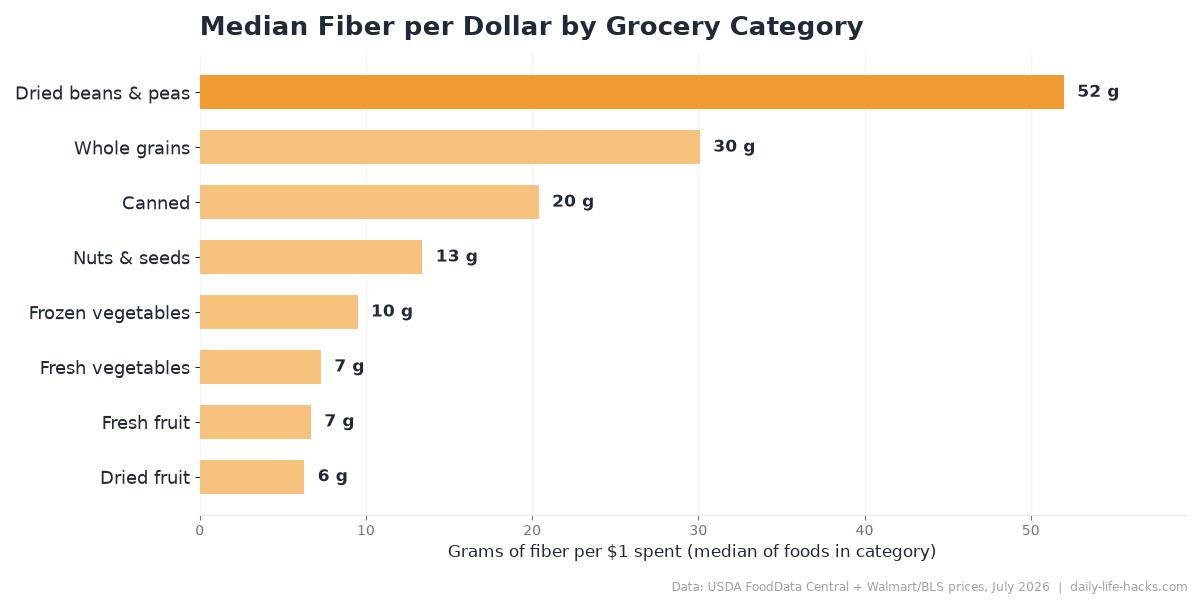
The dry goods aisle is running the table. Eleven of the top twelve foods are dried beans, peas, or whole grains. Whole wheat flour technically wins the whole list at about 78 grams of fiber per dollar, but flour is an ingredient, not dinner (more on that below). Among foods you can actually cook and eat, dry split peas take the crown at about 71 grams of fiber per dollar, roughly 16 times more than fresh raspberries and 28 times more than blueberries. One $1.42 bag of split peas holds around 101 grams of fiber. For context, the FDA’s Daily Value for fiber is 28 grams, so that single dollar-and-change bag covers about three and a half days’ worth. If you’ve never cooked them, our split pea soup recipe is the easy on-ramp.
Dry beans beat canned by 2.5x. Dry pinto beans came in around 71 grams of fiber per dollar; canned black beans, about 28. Canned is still a genuinely good deal, and I keep a shelf of them for lazy nights. But if the soaking step is the only thing stopping you, the same-day quick-soak method removes the excuse.
Popcorn is the sleeper hit. Plain kernels landed at number 5, ahead of lentils, oats, and every vegetable in the store. Fifty-eight grams of fiber per dollar for something that’s legitimately a snack. If you’re going to eat it anyway, some smarter popcorn toppings keep it from becoming a butter delivery system.
Frozen quietly beats fresh. Frozen green peas scored 17.6 grams per dollar; fresh broccoli crowns, 6.1. That matches what we found when we compared frozen versus fresh produce more broadly: the freezer aisle is where the value hides.
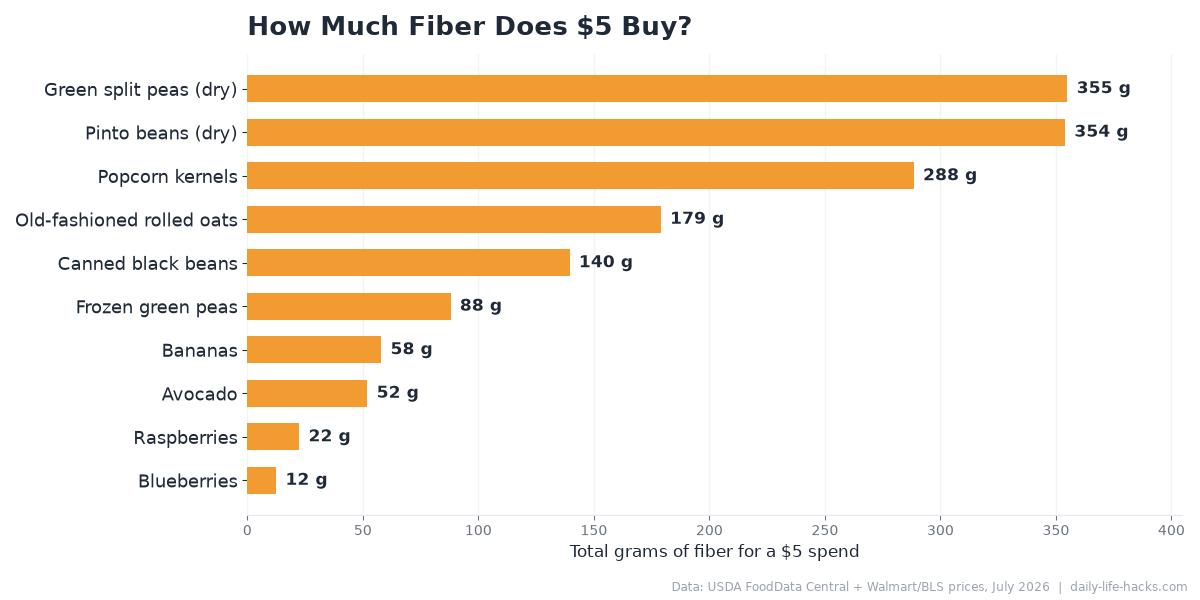
Berries are a luxury good, fiber-wise. The bottom four spots are all berries. Raspberries look impressive at 6.5 grams of fiber per 100 grams, but at $2.48 for a 6 ounce clamshell, you’re paying boutique prices. Five dollars buys 355 grams of fiber as split peas or 12 grams as blueberries.
The fine print on the top of the list
Two honest caveats before you fill a cart with split peas.
Whole wheat flour sits at number 1, and nobody eats flour with a spoon. It only counts if you bake, so treat it as a quiet upgrade: swap it into pancakes, muffins, and bread dough and the fiber tags along for pennies. If you want a number one you can actually put in a pot tonight, that’s split peas at number 2. Same asterisk applies to whole wheat spaghetti at number 9, except that one you can boil and eat on a Tuesday.
And ranking low doesn’t make a food bad. Berries, avocados, and Brussels sprouts bring things to the table that a bag of navy beans never will. This list answers exactly one question: where each fiber dollar goes furthest. It’s a map, not a meal plan.
How to actually use this
Don’t overhaul anything. Just let the top of the table cover the boring baseline, cheap and on autopilot, and spend your remaining grocery money on whatever you actually crave.
- Pick two pantry anchors. A bag of split peas or lentils and a bag of pinto beans is maybe $5.50 and more fiber than most of us see in two weeks.
- Make oats or bran flakes the default breakfast. Both sit in the top 20 and neither requires a recipe.
- Let frozen peas be your emergency vegetable. Ninety seconds in the microwave, 17.6 grams per dollar, zero chopping.
- Buy berries because you love them. Just don’t buy them as a fiber strategy.
If you want the bigger picture on stretching a grocery budget, our healthy eating on a budget shopping list pairs well with this table.
The whole analysis comes down to one sentence: the cheapest high-fiber foods in America live in the dry goods aisle, they cost about a quarter per 100 grams, and the store has been hiding them at knee level below the fancy stuff the whole time. Now you have the receipts.


